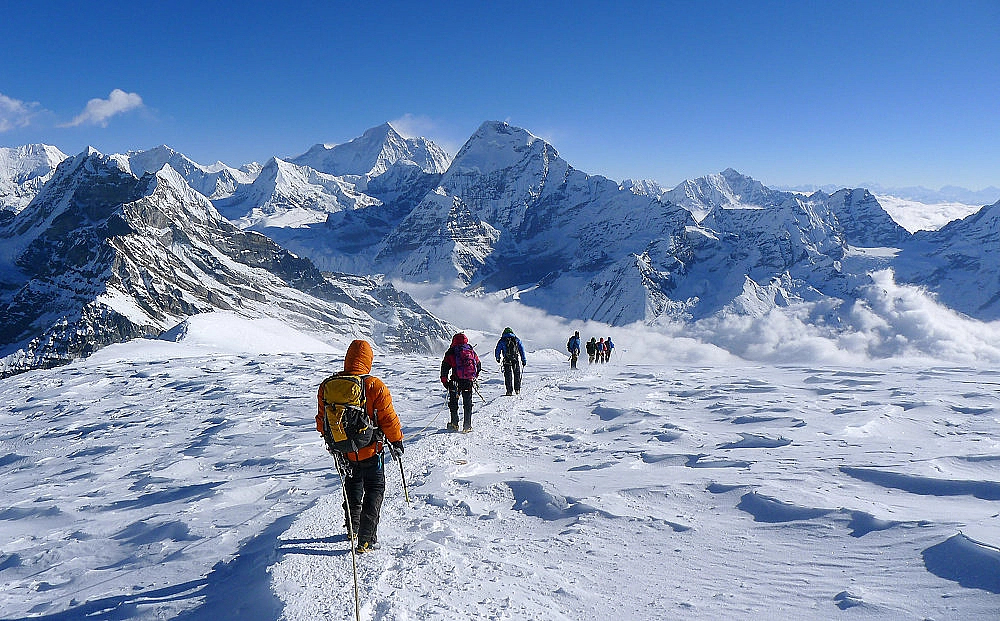
Mera Peak Sherpa Guide: An Unforgettable Adventure in the HimalayasClimbing Mera Peak with a Sherpa is an adventure of a lifetime that combines the excitement of mountaineering with the rich heritage of the Himalayas. Preparation is key to a successful and safe ascent. A structured expedition checklist will ensure that you leave no aspect of the trek whatsoever behind, including both physical and gear-related preparation!
Mera Peak climbing Most importantly, your physical preparation is very important. Mera Peak is 6,476 meters (21,246 feet), so trekkers must be physically fit to handle the rigors of high-altitude hiking. Cardio fitness matters, and climbers should be doing endurance-building activities, such as hiking, running, and cycling. Leg and core strength training also play a vital role in allowing for the difficult terrain and weight of the trekking gear. Weight training helps you build general strength, but when you also practice with a backpack to simulate the load you plan to carry (and endurance), you will be ready to hit the trail.
In terms of gear, what you use will be critical to a safe ascent. Basic climbing equipment consists of crampons, ice axes, a harness, a rope, a helmet, and a headlamp. Comfortable and weather-proof clothing is also necessary in order to stay warm and dry throughout the trekking. Layering is the best approach for changing weather, so come armed with a waterproof jacket, thermal layers, gloves, and hats. Moreover, robust, high-altitude boots will be required to traverse snow and ice-covered ground.
On the logistics front, you’ll need to apply for the correct permits. The trek requires a Mera Peak Climbing Permit, a Sagarmatha National Park permit, and a TIMS (Trekkers’ Information Management System) card. These permits are arranged through a registered trekking agency.
Lastly, don’t forget essentials like sunscreen, sunglasses, and personal medication. When you climb Mera Peak along with a Sherpa, you will receive expert guidance throughout the entire trip, so you will have a challenging adventure with an enormous degree of reward. The other half, though, comes down to training and gear so that you can actually get yourself up to the summit without hurting yourself.
Table of Contents
Mera Peak Climbing Overview
At 6,476 meters (21,247 feet), Mera Peak is the highest trekking peak in Nepal, often preferred by climbers who want to experience high-altitude mountaineering without the technical climbing requirements of larger peaks such as Mount Everest. Positioned within the Mahalangur range of the Himalayas, Mera Peak provides an exciting, though accessible, challenge for trekkers and climbers wishing to ascend a Himalayan peak. The ascent offers stunning views of some of the world’s tallest mountains, notably Everest, Lhotse, Makalu, and Cho Oyu, and is a dream spot for the adventurous at heart.
Unlike some of the other peaks in the Himalayas, Mera Peak does not require advanced technical climbing ability, making it an appealing choice for climbers with some experience trekking as well as basic mountaineering skills. The ascent requires some glacier travel, ice climbing and crack maneuvering but is appropriate for people in reasonable physical shape and able to use crampons and ice axes.
The trek to Mera Peak takes you through verdant forests, idyllic Sherpa towns, and harsh landscapes before you reach the summit. It is not just a trip to the top; it is also an opportunity to experience the unique culture of the Everest region as well as the stark beauty of the Himalayan landscape. When properly prepared, climbing Mera Peak will provide an exciting and unforgettable experience in one of the world’s most beautiful mountain ranges.
The Unique Benefits of Having a Sherpa on an Expedition
Climb Mera Peak An Experienced and reliable Sherpa for your Mera Peak expedition can prove to be a game-changer if you wish to submit successfully and safely. The role of Sherpas completely includes and is integral to mountaineering in Nepal and their experiences, knowledge, and assistance to climbers is something that cannot be expressed. They are local guides from the Everest region and have extensive knowledge of the terrain, weather patterns, and the challenges of altitude climbing. Their on-ground knowledge and experience of trails and climbs make the journey ahead seamless for trekkers and climbers alike.
Safety is one of the biggest advantages of having a Sherpa. Sherpas are well adapted to high-altitude environments and are able to detect the early signs of altitude sickness, advising climbers to avoid serious health complications. They have advanced skills in traversing crevasses, crossing glaciers and steep pitches, to keep climbers on the safest and most efficient path. Also, Sherpas carry heavy gear, so climbers can concentrate on the physical challenge of the ascent, rather than logistical worries.
Additionally, Sherpas provide cultural knowledge and a connection to the rich traditions of the Sherpa people. This helps you appreciate the beauty of the mountains on a spiritual level. They help with logistics but also provide encouragement and motivation on those hardest days on the way up. Their expertise also makes your Mera Peak climb safer as well as more enjoyable and immersive.
Best Time to Climb Mera Peak
The best season for the Mera Peak climb is during the pre-monsoon spring (March to May) and post-monsoon autumn (September to November) seasons. These windows provide the best weather conditions for high-altitude climbing, with relatively stable weather, clear skies, and moderate temperatures all vital for a safe and successful climb.
Mera Peak expedition is especially popular for climbing in spring (March to May). It’s warmer than the colder winter months in this season with lower chances of snowstorms or heavy rain. Climbers are treated to spectacular panoramic views of surrounding peaks, including Everest, Makalu, and Cho Oyu, from clear skies. That said, you still want to be ready for cooler weather at higher altitudes, especially at night.
Peak climbing season leads up to the autumn months (September to November), when the monsoon season has just passed, leaving dry trails and stable weather. The air is fresh, and the skies are frequently blue, providing a great view of the Himalayan peaks. While temperatures are cooler than in spring, the weather is generally dependable, with low odds of snow and other weather-related disruptions.
Both seasons miss the extreme winters and heavy rains of the summer monsoon, hence are the best times for a safe and comfortable Mera Peak climbing. When the temperatures drop, climbers should still be ready for the conditions and the difficulties of high-altitude mountaineering.
Climbing Physical Fitness Guidelines
The Summit of Mera Peak is physically challenging, so it requires adequate physical preparation for a successful and safe summit. The trek itself does not demand a high technical climbing skill set, but high fitness is required due to altitude, terrain, and endurance. Trekkers need to be physically fit, and ready for long climbs, fast weather changes, and fears of high-altitude sicknesses.
Endurance training forms part of the physical preparation. Cardiovascular work like running, removing, and hiking are key to building stamina and growing aerobatics. Getting out on longer walks while wearing a weighted pack is arguably the best way to prepare because it mimics the physical challenge of the actual trek. Strength training, especially of the legs, core and upper body, is just as vital to help climbers navigate the steep and uneven terrain faced during the climb. Leg workouts like squats, lunges, and step-ups improve strength in the legs, while core exercises such as planks and Russian twists build stability and balance.
Along with physical training, you should altitude condition your body to the elevation by going up gradually. Spending time at a similar altitude as encountered in the Mera Peak trek or embarking on multiple-day hikes in the mountains will enable your body to acclimatize to depleted oxygen levels. Mental preparation is also necessary because the challenge of the ascent requires both physical resilience and the ability to deal with the physical and psychological stresses of the high-altitude environment. Even without prior experience, climbers who build up the necessary fitness and mental resilience can tackle Mera Peak.
Gear and Equipment Needed for Mera Peak
Like any other high-peak climbing, Mera peak climbing also requires specific gear and equipment for a successful and safe expedition. Proper equipment is critical to dealing with the high-altitude environment, tough topography, and frigid conditions that climbers experience. Here are some of the most important gear to bring along for the climb:
Mera Peak climbing cost Clothes: Several layers are necessary because the weather keeps changing. You will need a moisture-wicking base layer, an insulating mid-layer, like a fleece or down jacket, and a waterproof, windproof outer layer. Don’t forget to bring a warm hat, gloves, and thermal socks to keep your extremities warm.
Footwear: You will need robust, waterproof trekking boots that provide adequate ankle support to tackle the rugged, rocky terrain and snow-covered areas. Bring crampons for icy areas and gaiters to keep snow and debris off your legs.
Climbing Gear: Required climbing equipment is an ice axe, crampons, a climbing harness, and a helmet. These are essential for navigating the icy and snowy terrain on the upper sections of the ascent.
Sleeping Bag & Tent: A four-season tent offers protection from the elements, and a down sleeping bag that can handle extreme cold (as low as -20 °C or -4 °F) is essential.
Other Essentials: Trekking poles help with balance, and a durable 40-50-liter backpack is necessary to conform to your equipment. An arsenal of gear is required to make the climb: a headlamp, sunscreen, water purification tablets, a first-aid kit, and high-energy snacks.
The right gear is important to ensure you are safe and comfortable during your Mera Peak expedition so that you can put your efforts toward the physical and mental grind of the climb itself.
Assessing the Climbing Route
Climbing up to the Mera Peak trek combines trekking with some mountaineering as it leads climbers through an array of environments including forested slopes, glacial moraine, and snowy fields. Often, the journey begins with a flight from Kathmandu to Lukla, the start of the trek to Mera Peak. From Lukla, climbers take established trekking routes north toward Namche Bazaar, through traditional Sherpa villages, verdant forests, and rhododendron forests.
From there, after Namche Bazaar, the route proceeds toward Thuli Kharka, where climbers will get their first look at Mera Peak. From here, trekkers make their way to Mera Base Camp, at about 5,300 meters (17,400 feet). The Base Camp is the main point to begin with the ascent to the summit. Base Camp is where climbers stay for a few days to acclimatize before proceeding to higher camps.
Mera Peak summit The next section of the route ascends to Camp I (5,800 meters / 19,029 feet) and from there to Camp II (6,000 meters / 19,685 feet). These camps play a crucial role in acclimatization and preparing for the final ascent towards the summit. The last part of the journey requires traversing a glacier, and crampons and ice axes come in handy to deal with its frozen steps. At the summit, climbers are rewarded with views of some of the world’s highest peaks — including Mount Everest, Lhotse, and Makalu.
Knowing the route is essential for being properly prepared. It’s important to take it easy, ensuring proper rest and acclimatization to deal with the difficulties of the climb.
A Mera Peak Acclimatization Plan
Acclimatization is one of the most important things for your Mera Peak climb to be successful, that is because climbing at high altitudes can affect your body significantly. Mera Peak is at 6,476 meters (21,246 feet) above sea level, and some of them may not have acclimatized properly at those heights, which can bring on life-threatening altitude sickness. How to prevent this? — Make sure to ascend slowly to give your body enough time to adjust to the poor oxygen saturation.
The trekking route for Mera Peak is also set up for acclimatization so that climbers are not climbing too fast. The itinerary has plenty of regular rest days—especially after crossing critical milestones like Namche Bazaar and Dingboche at altitude. Though climbers take rest days at those high base camps, they use “climb high, sleep low” techniques, ascending higher than they plan to summit during the day and returning to lower altitudes during the night to help the body acclimatize.
Hydration and good nutrition are also key to acclimatization. Vigorous hydration also helps avoid dehydration, which can worsen the signs and symptoms of altitude sickness. High-energy foods are also vital to maintaining energy levels and assisting the body cope with the demands of the trek. It’s important to listen to your body — if you are experiencing any symptoms of altitude sickness, including dizziness, headache, and nausea, you must let your guide know and act; in most cases, this means descending to a lower elevation.
Sherpas in the Expedition
Sherpas are key to the success and safety of any Mera Peak expedition. Not only they are guides, but they are also highly skilled professionals and highly experienced men about the Himalayan terrains. Famous for their profound acclimatization skills and deep connection to the mountains, Sherpas guide trekkers through the physically demanding climb with ease and confidence.
Mera Peak climbing weather One of the main jobs of Sherpas is to keep the group safe. With their in-depth understanding of the Mera Peak route and common hazards like crevasses and unpredictable weather, they can make life-saving decisions at the moment, keeping the group on the safest path possible. They also help bear heavy loads, pitch tents, and guide trekkers through technical parts of the climb.
In addition to their technical skills, Sherpas offer emotional and cultural support, educating trekkers on the Sherpa lifestyle. It is so warm to their people that the trail is richer and makes more sense. They’re also extremely religious people whose relationship with the mountains is on another level, which was a bridge for most climbers to understand the spiritual aspect of the region, and it seems many of them returned from the mountain with a new appreciation of the fact that the Himalayas are the cultural center of the Sherpas.
Summit risk reduction, safety, and cultural experience provided by a professional Sherpa guide embodies the spirit of Mera Peak trekking. Their support makes the expedition a success not only physically but culturally as well.
Safety and Risk Management in Climbing
You can read below why Mera Peak is a dangerous trek in general. Backpacking in the Himalayas reaches a uniquely beautiful and dangerous place. Appropriate safety and risk management measures are essential for the safety of climbers at every stage of the expedition.
Altitude sickness is one such risk management measure that can be taken right from the outside. The best way to reduce that risk is to climb slowly and steadily so that the body has enough time to adjust to lower levels of oxygen. Plenty of acclimatization days are included in the itinerary, and climbers are encouraged to take rest days as needed. Helium and a well-balanced meal After the three essentials for sleep discomfort.
A major component of safety is making sure climbers have the right gear. The final push to the summit of Mera Peak involves the use of crampons, ice axes, helmets, and harnesses. This ensures climbers can navigate the glacier and icy terrain while minimizing the chance of slips or falls.
The weather in the Himalayas can change in an instant, so definitely keep track of forecasts and prepare for rain, snow, or extreme cold. Sherpas are also highly trained in recognizing weather patterns and will act accordingly, whether that be changing the itinerary or turning back if conditions are too dangerous.
Finally, emergency evacuation plans must be initiated, and one must have satellite phones or radios to be in touch with base camps or rescue teams. By adhering to these safety procedures and traveling with experienced Sherpas, trekkers can greatly mitigate the risks of Mera Peak climbing.
Legal Requirements: Permits
Mera Peak climbing price As established by the Nepalese government, climbing Mera Peak requires several permits to be obtained as well as specific legal requirements to be fulfilled. These permits ensure that the trek is done legally, sustainably, and safely. The main one you need to enter is the Mera Peak climbing permit, given out by the Nepal Mountaineering Association (NMA). This permit is required for anyone attempting the summit and grants trekkers access to the mountain. This is a necessary permit that must be obtained via a licensed trekking agency in Nepal that will manage the application and fee process for you.
Trekkers also need to get a Sagarmatha National Park entry permit. This is the protected area, with rich wildlife and unique beauty, through which the trekking route of Mera Peak passes. The permit contributes to the park’s conservation activities and ensures that trekkers follow environmental regulations.
The TIMS (Trekkers’ Information Management System) card is another essential permit that ensures the safety and tracking of trekkers on their journey. It is a Mandatory pass for trekking in Nepal which helps authorities know about trekkers, their routes, and destinations.
Climbers must also consider local rules, such as waste-management regulations. Nepal’s regulations for trekking minimize environmental degradation, and climbers must pack out all waste, including toilet paper, in order to maintain the unspoiled wilderness of the area.
Obtaining the appropriate permits and adhering to these legal obligations assist trekkers in the preservation of Nepal’s cultural and natural legacy as well as avoid making their climb illegal and disorganized.
How much does it cost to climb Mera Peak?
A Mera Peak expedition requires dozens of important considerations and budgeting for it all is definitely one of the most significant, as climbing these high-altitude giants comes with several costs that must be covered beforehand. It normally costs from $2,500 USD to $5,000 USD depending on the trekking agency you choose to get the best facilities and comfort.
Climbing permit: This is one of the biggest expenses; the normal fee ranges from $250-$350 US dollars depending on whether it is the peak season or not. Lastly, the entrance permit for Sagarmatha National Park and TIMS (Trekkers’ Information Management System) card would also cost you an additional 50 – 100 USD.
Another major cost is hiring an experienced Sherpa guide, which can range from $1,000 to $2,000 USD. This charge also reflects their experience in traversing the mountain, as well as keeping climbers safe and providing logistical support through the journey. Porters can also be hired for personal belongings, which puts another hole in the pocket.
Another key component of the budget is transportation. Flights to Lukla from Kathmandu – the gateway for the Everest region – normally range from $300 and $500 USD round trip. Accommodation, meals, and trekking gear are other expenses, which can be significant, especially when you need to rent equipment.
Finally, please also consider travel insurance, including coverage for emergencies like needing to be evacuated, which can be between $100 and $300 USD. With proper knowledge and attention to costs, expeditions to Mera Peak can be financially sound and trouble-free.
Final Step for the Summit: Business and Relocation Plan
When preparing to climb Mera Peak, the final days of the expedition can be one of the most important, potentially impacting the likelihood of a successful summit. Your physical condition First, check your physical condition. Now is not much time though, so you need to be training focused on endurance and strength. Take long walks with a weighted pack to mimic the hike and carry the required weight. Climb your summit after you have truly acclimatized (this should be done well prior to the ascent, otherwise you will be unable to avoid altitude sickness en route).
Next, make sure you are done with your gear checklist. Be sure to have all the necessary climbing gear, including crampons, ice axes, and a helmet. Wear layers of clothing, Mera Peak climbing packing list includes a high-quality waterproof jacket, thermal layers, gloves, and hats to help manage the changing temperatures. Remember important items like sunscreen sunglasses and a first-aid kit.
And be sure to double-check your documentation and permits. The trek requires you to have your Mera Peak climbing permit, TIMS card, and Sagarmatha National Park entry permit in shape. Also, make sure your travel insurance covers emergencies, like evacuation.
Lastly, give yourself time to mentally prepare yourself to climb. It’s also important to recognize that the trek is challenging and is one of the highest-altitude treks. With the correct physical preparation, suitable equipment, and the leadership of skilled Sherpas, you should be set for a successful summit of Mera Peak.